DAU/MAU ratio for games: how to calculate stickiness
 By Mike Dalton ·

DAU/MAU, also called stickiness, is the number of daily active players divided by the number of monthly active players. It shows on how many days of a month a typical monthly player plays: the higher the ratio, the more often players come back.
How to calculate DAU/MAU
Start with three counts, each of distinct players:
- DAU (daily active users) is the number of players who played on a day.
- WAU (weekly active users) is the number of players who played in the 7 days ending on that day.
- MAU (monthly active users) is the number of players who played in the 30 days ending on that day.
DAU/MAU is DAU divided by MAU. If 2,000 players played in the last 30 days and 400 of them played today, DAU/MAU is 400 / 2,000 = 20%.
The ratio converts to days played. Over a 30-day window, the sum of DAU divided by MAU is the average number of days each monthly player played. So an average DAU/MAU of 20% means a monthly player plays on about 6 of 30 days, and 10% means about 3 days.
DAU/WAU is the same idea over a week. It is useful for games that players open in short bursts, because a month is long enough to hide a drop that started last week.
Rolling 30 days or calendar month
MAU has two common definitions, and they give different ratios for the same players:
- Rolling 30 days: MAU on a day counts the players active in the 30 days ending on that day. Every day has its own MAU, so you can chart DAU/MAU day by day. Mixpanel's MAU, for example, counts the users active within the last 30 days of each date.
- Calendar month: MAU counts the players active from the first day of the month. On the 1st, MAU only includes that day's players, so DAU/MAU is 100%. As the month goes on, MAU grows and the ratio falls, even when nothing in the game changed.
Some reports also average DAU over a calendar month and divide by that month's MAU, which gives one number per month. All three are valid, but you can only compare numbers calculated the same way. Before you compare your ratio with a benchmark or another tool, check which definition each one uses.
SQL query for DAU, WAU, and MAU
If your sessions are already in a database, this PostgreSQL query calculates DAU, WAU, MAU, and DAU/MAU for every finished day, with rolling windows. It expects a sessions table with a player_id column and a started_at column of type timestamptz:
WITH active_days AS (
  SELECT DISTINCT player_id, (started_at AT TIME ZONE 'UTC')::date AS active_on
  FROM sessions
),
days AS (
  SELECT day::date AS day
  FROM generate_series(
    (SELECT MIN(active_on) FROM active_days),
    (now() AT TIME ZONE 'UTC')::date - 1,
    interval '1 day'
  ) AS day
)
SELECT
  days.day,
  COUNT(DISTINCT player_id) FILTER (WHERE active_on = days.day) AS dau,
  COUNT(DISTINCT player_id) FILTER (WHERE active_on > days.day - 7) AS wau,
  COUNT(DISTINCT player_id) AS mau,
  ROUND(100.0 * COUNT(DISTINCT player_id) FILTER (WHERE active_on = days.day) / COUNT(DISTINCT player_id), 1) AS dau_mau_percent
FROM days
JOIN active_days ON active_on BETWEEN days.day - 29 AND days.day
GROUP BY days.day
ORDER BY days.day DESC;
The query reduces sessions to one row per player per day, then joins each day with the 30 days ending on it. MAU counts every player in that window, WAU counts the players in its last 7 days, and DAU counts the players on the day itself. It stops at yesterday, because today's DAU is not final until the day ends. Days are calendar days in UTC; to use a local time zone instead, replace both 'UTC' values with a zone name such as 'America/New_York'.
The same table works with the retention query, so you can calculate both from one source.
What changes the ratio in a game
DAU/MAU moves for reasons that have nothing to do with how good the game is. These are the usual ones:
- Launch. For the first 30 days after launch, MAU only counts the players since launch. On the first day every player is new, so DAU/MAU is 100%, and it falls every day until the window is full. In the example game below, it went from 100% on launch day to 70% on the second day, and settled around 11% after the first month.
- New players. A wave of players who try the game once raises MAU for 30 days but DAU for only a day or two, so the ratio falls while the game grows. A store feature, a sale, or paid acquisition has this effect.
- Weekends, events, and updates. These raise DAU for a few days, so the daily ratio rises and falls with them. Compare averages over at least a week, or compare the same weekday.
- What counts as active. Opening the game, finishing a match, or sending any event. A stricter definition lowers DAU more than MAU, so the ratio falls.
What is a good DAU/MAU for a game?
The GameAnalytics 2026 benchmarks publish DAU/MAU for 3,582 PC games during 2025:
| PC games | DAU/MAU |
|---|---|
| Median | 4% to 5% |
| Top 25% | about 7% |
| Top 10% | 13% to 15% |
GameAnalytics does not publish DAU/MAU for mobile games.
You will also see targets such as 20% for a good product and 50% for an excellent one. As Andrew Chen explains, those numbers come from social apps that people open every day. Products that people use now and then can do well with a much lower ratio, and many games are played that way.
The comparison that tells you more is your game against itself: this month against earlier months, counted from at least 30 days after launch.
When DAU/MAU misleads
A ratio can improve while the game gets worse. If players who try the game once stop arriving, MAU falls faster than DAU and DAU/MAU rises, even though fewer people play. Always read the ratio next to DAU and MAU, not on its own.
DAU/MAU also says nothing about new players. A game can keep a loyal group of daily players while almost every new player leaves after the first session. D1 and D7 retention answer that question, so track them together.
DAU, WAU, and MAU in Game Stats AI
To show what that looks like, we used the example competitive game from the retention guide: new players joined every day for eight weeks, and every match was sent to the matches endpoint.
A retention report counts a player as active on any day they play a match, send an event, unlock an achievement, or record a progression event. It charts daily, weekly, and monthly active players for every finished UTC day, with rolling 7-day and 30-day windows, and shows the averages for each one and for stickiness:
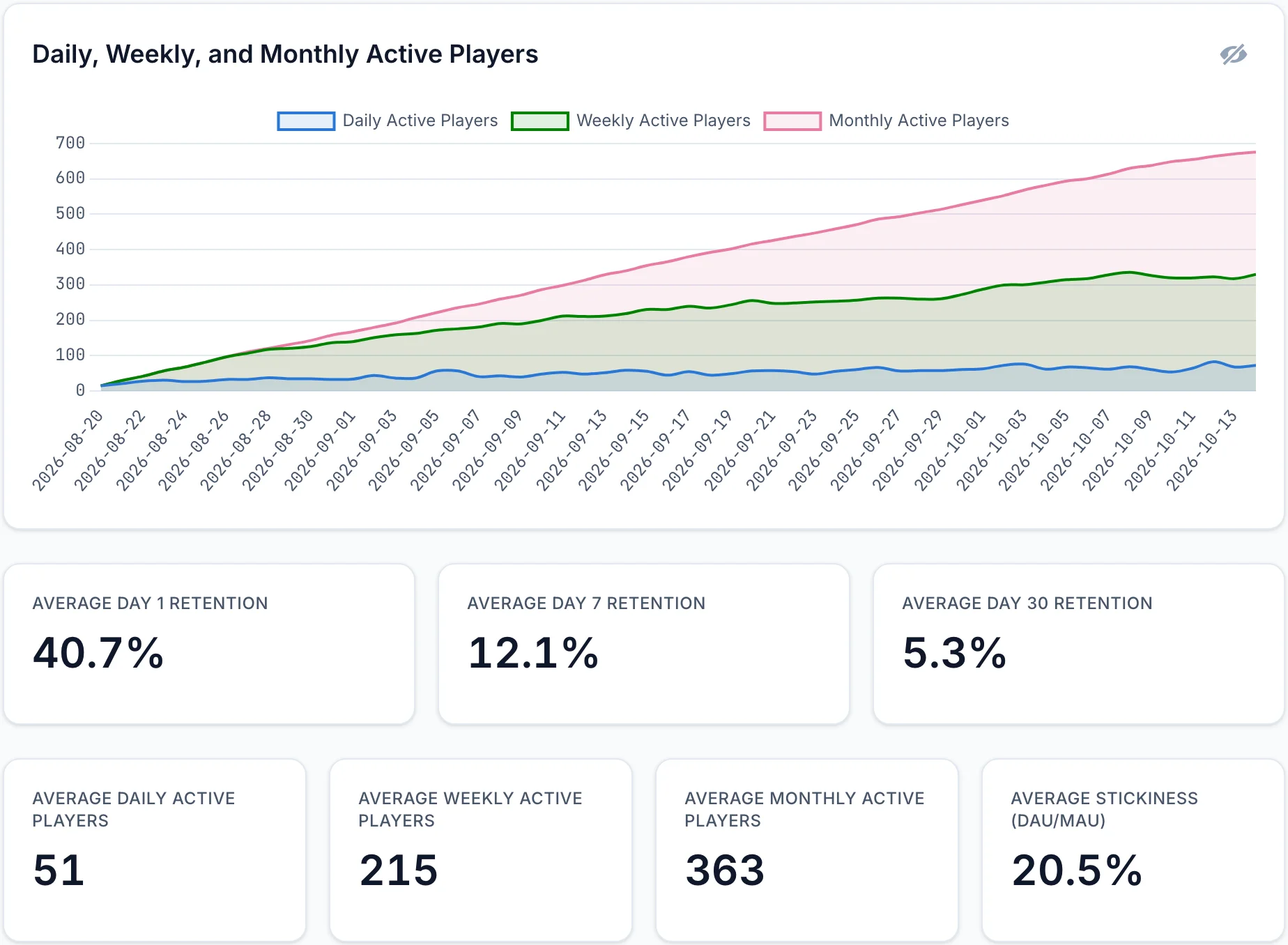
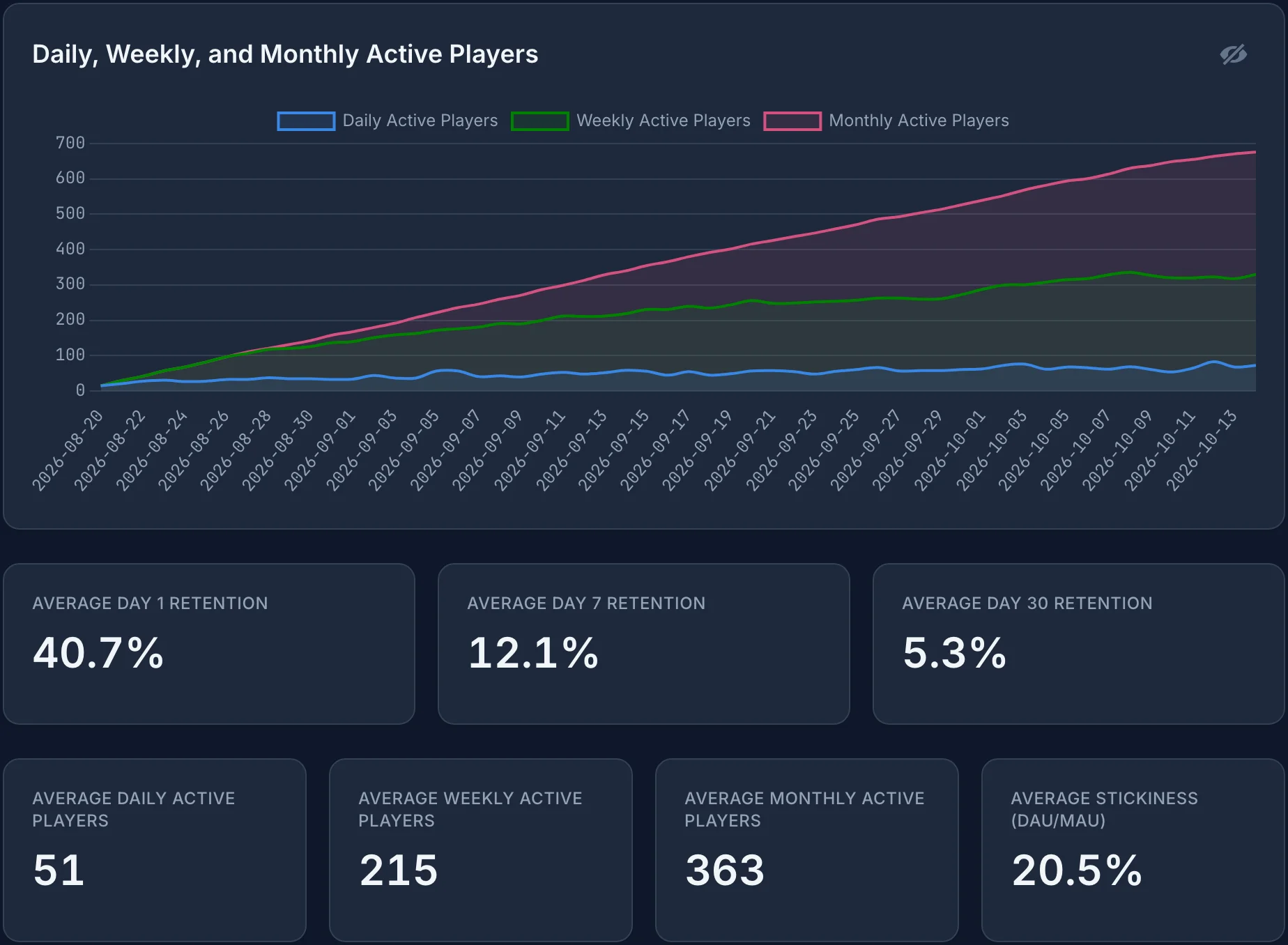
The average stickiness of 20.5% includes the launch. On the last day, 73 of 676 monthly active players played, a DAU/MAU of 10.8%, and over the last 30 days the average is 11.8%. To leave out the launch, choose a date range that starts at least 30 days after it. We ran the SQL query above on the same matches, and it returned the same DAU, WAU, MAU, and ratio for every day.
The same values are available from the retention report endpoint, and you can ask Claude about them through MCP, for example How did our DAU/MAU change after the last update?
For the other numbers to track next to it, see mobile game KPIs.
Frequently asked questions
What does DAU/MAU mean?
DAU/MAU is daily active users divided by monthly active users. It shows what share of the players from the last 30 days played on a given day.
What is the difference between DAU and MAU?
DAU counts the distinct players on one day. MAU counts the distinct players over 30 days, so a player who plays every day counts 30 times in the sum of DAU but once in MAU.
What is the difference between DAU, WAU, and MAU?
They count distinct players over different windows: one day, 7 days, and 30 days. WAU and MAU are usually rolling windows that end on the day you look at.
Is a higher DAU/MAU always better?
No. The ratio rises when players who try the game once stop arriving, even though the game is shrinking. Read it next to DAU, MAU, and retention.